Wednesday, August 31, 2005

Willow Creek Community Church in the News

High-Tech Circuit Riders: Satellite churches are discovering a new way to grow the body of Christ by Bob Smietana

...almost 1,000 U.S. churches [have embraced] a multisite approach, according to the Leadership Network (www.leadnet.org). Sometimes called a "satellite" or "franchise" model, going multisite is seen by advocates as one of the leading innovations of the 21st century and by critics as a sign that the church has sold out to consumerism—becoming just another big-box retailer, selling salvation with convenient hours and a discount price. The answer, as usual, lies somewhere in between.

The article profiles several different churches' satellite operations. One of the more intrigueing models is that of Life Church in Oklahoma City. Life Church has a combined attendance of 14,000, but splits the congregation up into five seperate locations. Their pastor, Craig Groeschel, explains;

"People like the options and quality of megachurches, yet crave the intimacy of smaller churches," Groeschel told CT. "This model gives you both. You can go to an experience that may have 200 people and dive into deep biblical community with them, and at the same time, you have the option of going on any one of 25 different mission trips during the year. So you get the benefits of a smaller community with the benefits of a megachurch."

Along with New Life, Smietana profiles Seacoast Church of South Carolina, Bayside Church in California, and two Chicagoland churches; Harvest Bible Chapel and Willow Creek Community Church.

Willow Creek started its Wheaton satellite campus in 2001 as a response to "the 30-minute problem." Jim Tomberlin, who oversees Willow's three satellite campuses, says that once people drive more than 30 minutes one way to church, their involvement drops off dramatically. More than one-third of Willow attendees were driving that far—and as a result, were not joining small groups or inviting their friends to church. That was undermining Willow's whole model, Tomberlin told CT.


Roger Finke, a sociologist from Penn State, notes an interesting historical parallel between the satellite movement and the very successful model employed by the Methodist circuit riders of the 19th century.

"The Methodist circuit rider was basically the pastor for multiple satellite churches," Finke told CT. "They tried to start up satellite congregations as quickly and as cheaply as possible. When the circuit rider was not there during the week, the satellite had a class leader or layperson who kept things going. Then the circuit rider would come in every once in a while and fire people up."

Methodists used that approach to become one of the largest religious groups in the United States, moving from "less than 2.5 percent of church adherents in 1776 to more than 34.2 percent in 1850," Finke wrote in a 2004 article for the Journal for the Scientific Study of Religion.

Friday, August 26, 2005

Friday's Random Ten, Part 2

Sorry I haven't been very sociable lately - still sick, and dizzy, and confused. Without further ado...here's the random ten for this week.

  1. The Tourist, Radiohead (Ok Computer)
  2. Stick in the Mud, Jayhawks (Sound of Lies)
  3. Balaam's Ass, Vigilantes of Love (Blister Soul)
  4. I Will Miss You Girl, Bill Mallonee (Dear Life)
  5. Is That You, Buddy Miller (Universal United House of Prayer)
  6. Downtown Lights, Annie Lennox (Medusa)
  7. You are So Good, Third Day (Offerings II)
  8. Come Together, Beatles (1)
  9. Michael, Franz Ferdinand (Franz Ferdinand)
  10. Reasonable Service, Lost Dogs (Green Room Serenade)


Malachy's favorite is Michael, my favorite is Balaam's Ass, Steph's favorite is Stick in the Mud.

Wednesday, August 24, 2005

Tuesday, August 23, 2005

Find the Big Jesus

I haven't read Velvet Elvis yet, but I have been following y'alls comments on it, so I was happy to discover Thunderstruck's link to this BeliefNet interview with Bell. They square away the orthodoxy question in the first paragraph of the interview and then get on to the juicy stuff.

Monday, August 22, 2005

Vermont

This is another old one. I did this one as a sketch for a larger painting that I donated to a charity auction. I don't usually enjoy painting landscapes (when I finish a painting I want to be looking at somebody, not something) but I did enjoy this one.

Cute Fuzzy Bunnies


To make up for the using the word "nudist" in my last entry, I'm posting this painting. What it lacks in style, technique, and originality it makes up for in bunnies.

Malachy was born October 21st, 2004. Eventually, visiting hours were over and they made me go home. Experiencing seperation anxiety, I got out the paints and painted some little babies to keep me company.

It's based on a painting in a library book I had at the time, but I never wrote down what it was so I'm afraid I can't give due credit.

PS It's not as wrinkled in life as the scan makes it look.

Nudist Colony

One thing posting my paintings has done is thickened my skin a bit, so I'm finally ready to post some of my fiction. Unlike paintings, my stories never feel "done," so comments and critiques are more than welcome.

The link is in the title.

More stories coming soon.

Fibromyalgia in the News

These are great times for folks with FMS. The research is picking up, public awareness is growing, and more effective treatments are becoming available. My mother went an entire decade without seeing as many advances as we have seen in just the past two years.

On Pain's Trail (by Shari Roan of the L.A. Times) explains some of these recent breakthroughs in laymen's terms, shares the personal story of an FMS sufferer, and provides a glimpse at the insulting skepticism those of us with FMS often encounter.

It also sexes up "tender points." I don't think I've seen this chart at my doc's office.

I recommend reading the article, but if you don't feel like it, here are some of the most interesting parts:

For years doctors had been looking for a cause of fibromyalgia at the site of the pain: the head, back, hands, neck, gut or elsewhere. And their treatments focused on soothing pain in these locations. As their understanding has grown, however, these treatments have begun to change and new ones are in development.

Fibromyalgia is now thought to arise from miscommunication among nerve impulses in the central nervous system, in other words the brain and spinal cord. This "central sensitization" theory is described in detail this month in a supplement of the Journal of Rheumatology. The neurons, which send messages to the brain, become excitable, exaggerating the pain sensation, researchers have found.

As a result, fibromyalgia patients feel intense pain when they should feel only mild fatigue or discomfort — such as after hauling bags of groceries. They sometimes feel pain even when there is no cause.

The "central sensitization" theory may be the common link between FMS and several other mysterious conditions, including irritable bowel syndrome, gulf war syndrome, and endometriosis. According to the article, doctors hope that breakthroughs in FMS research will help them understand these diseases as well.

The article also speculates that Fibromyalgia drugs may be available as early as 2006, and includes a list of half a dozen promising drugs being studied. Greater understanding of physiological abnormalities in FMS sufferers has paved the way.

Recent studies show multiple triggers for the amped-up response to pain. Fibromyalgia patients have, for instance, elevated levels of substance P, a neurotransmitter found in the spinal cord that is involved in communicating pain signals.

They also appear to have lower levels of substances that diminish the pain sensation, such as the brain chemicals serotonin, norepinephrine and dopamine. Growth hormone, which helps promote bone and muscle repair, is also found in lower levels in fibromyalgia patients.

New therapies are aimed at these abnormalities.

The drugs and what they do:
• Pregabalin (brand name Lyrica): This antiepileptic drug, also approved for diabetic nerve pain, appears to be effective in reducing pain and disturbed sleep in fibromyalgia patients. If late-stage trials prove successful, Pfizer plans to ask the FDA to approve the drug for fibromyalgia.

• Milnacipran: Marketed outside the United States as an antidepressant, this drug increases the brain chemicals norepinephrine and serotonin. Early studies showed it to be successful in reducing fibromyalgia pain, and data from the first phase-three trial is due out this fall. Cypress Bioscience and Forest Laboratories hope to seek FDA approval late next year.

• Duloxetine (brand name Cymbalta): This antidepressant, already on the market, increases the activity of serotonin and norepinephrine. It was successful in reducing fibromyalgia pain in early-phase studies, and plans for a phase-three study are underway. If successful, Lilly may seek FDA approval of the medication for fibromyalgia.

• Xyrem: Approved for narcolepsy with the complication of weak or paralyzed muscles, the drug might be able to increase deep sleep in people with fibromyalgia. The results of an initial study on fibromyalgia are due later this year. It's made by Jazz Pharmaceuticals.

• Provigil: Approved for daytime sleepiness associated with narcolepsy and shift-work disorders, or sleep problems in those who work nights or on changing schedules, the medication might help treat fatigue related to fibromyalgia. The manufacturer, Cephalon Inc., has no plans to seek approval for the drug for this purpose, but it can be used off-label.

• Mirapex: Approved for Parkinson's disease, this drug works by increasing the neurotransmitter dopamine. The manufacturer, Boehringer Ingelheim, has no plans to study the drug for use in fibromyalgia, but it can be used off-label. An independent study showed it was promising for reducing fibromyalgia pain.

Saturday, August 20, 2005

Happy B-Day Stephanie Rene!

You are sunshine to everyone who knows you and the best boss a sister could have!


Looking for music?


Remember Alive, one of the Best Worhsip Albums of '02, according to CT mag? It had such an impact that blogs were named after it, short stories were inspired by it, and I heard even Bono got a copy.

If you've been eagerly awaiting some more awesome Aaron music, Mars Hill has released Changed. Click here to listen to samples and get your own copy.

These songs don't sound a thing like most of the worhsip music out there right now. Original and hard to forget. The kind of stuff you crank up when you're driving. I love this cd. "Changed" and "Carry Each Other" are particularly fun to dance with a baby to.

Friday, August 19, 2005

Willow Creek Community Church in the News

We weren't the only ones to notice that this year's Summit was a bit different than usual. The Baptist Standard speculates this may be a sign of good things to come. (For the entire article click on the link in the title.)
This month, in a Leadership Summit simulcast attended by 50,000 local-church leaders in about 100 sites across the nation, megachurch pastors Bill Hybels of Willow Creek Community Church near Chicago and Rick Warren of Saddleback Community Church in Southern California hammered the beat-poverty theme. Warren repeated a message he delivered to the BWA--local churches can battle hunger at home and around the world. Hybels stressed that injustice, extreme poverty, hunger and AIDS ought to generate "holy discontent" among U.S. Christians so that they act out of passion.

Listening to Hybels and Warren call for an end to hunger, a question played through my mind: "What if all their followers take them up on this? We really could make hunger history." During three decades, Hybels and Warren have built two of the nation's largest churches. Tens of thousands of pastors and other church leaders hang on their every word. When they roll out a plan for church growth, thousands of churches follow it to the letter. So, what if Christians everywhere catch their zeal for eliminating hunger and poverty?

Leadership Summit Follow-up: Can't Stanz No More

Remember, unless you start implementing changes within three days of the conference, you're not likely to see any significant improvements in 12 month's time.

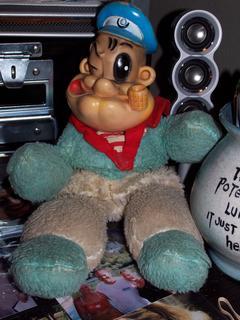
When the awesome Brian C. Berry got home he wanted to make sure he didn't sit on what he'd learned, so he put Popeye on his desk to remind him of what he can't stand no more.

Thanks for the great visual, Brian!